Key Management
Generates keys and manages locking and unlocking.

zkWallet Custody
zkWallet Custody : High-Security MPC-Based Wallet ServicezkWallet Custody splits private keys into multiple shards and only co-signs policy-verified transactions across multiple nodes — an MPC-based high-security Wallet Service.
Digital Asset Enterprise
Beyond key storage — providing generation, rotation, recovery, revocation, and institutional-grade control. KMS/HSM integration supports FIPS 140-2 Level 3+.
Problem
In a digital asset wallet, the private key is asset access itself. A single leaked mnemonic or master seed can lead to total asset theft.
A single master seed leak leads to complete asset theft.
Concentrated issuance and withdrawal authority increases the risk of unauthorized execution.
High-risk operations can execute without approval or policy verification.
Identifying root causes and recovering from failures or key issues is difficult.
The question is not how to store the key — it is ensuring the key is never concentrated in one place.
Why MPC
Eliminating single-key exposure risk by never concentrating the private key in one place.
What the Product Does
Receives key generation and transaction signing requests from financial services, processes them via MPC, and broadcasts signed transactions to the blockchain.
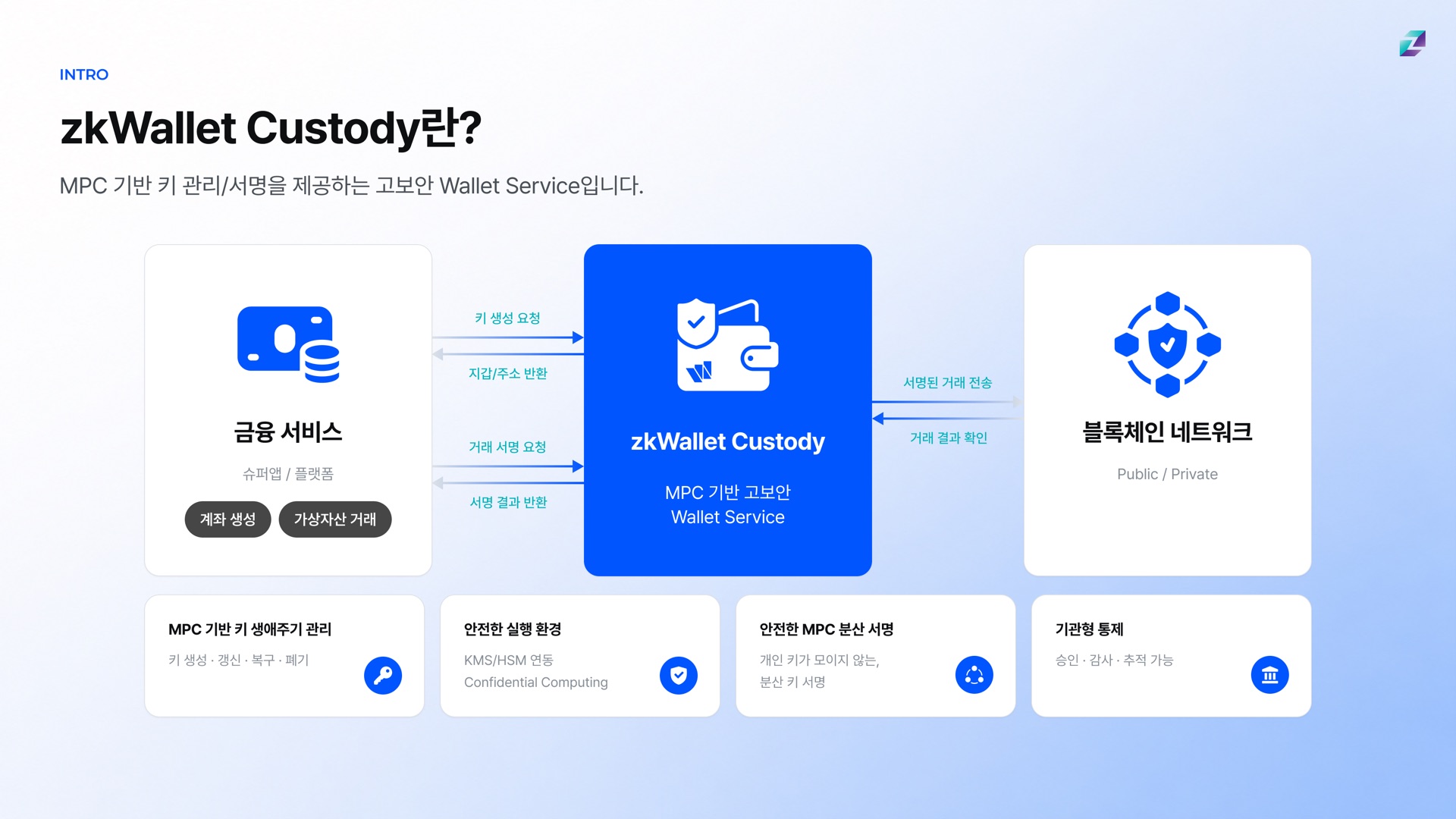
Generates keys and manages locking and unlocking.
Creates wallets and issues addresses.
Generates and verifies signatures.
Applies transaction limits and withdrawal approval policies.
Manages signing sessions and participating nodes.
Securely stores secrets and master keys.
MPC Signing
Key shards A, B, and C each produce a partial signature, which the Manager combines into a final signature.
Transaction signing requests proceed only after policy verification, and are completed by combining partial signatures — never by reconstructing the original key.
Evidence
An institutional Wallet Service needs more than just signing. zkWallet Custody provides key lifecycle management, protected execution environment, and institutional controls together.
Unified management of generation (DKG), rotation (Proactive Refresh), recovery, and revocation.
Protects key operations via Confidential Computing and external KMS/HSM integration.
Performs (t/n) threshold co-signing without ever concentrating key shards in one place.
Controls operations via Policy Engine, Identifiable Abort, and high-availability architecture.
Next Steps
Review whether an on-premise (server/cloud) or Confidential Computing all-in-one deployment best fits your security requirements.